
Bad freight brokers are becoming more sophisticated. Some operate without proper authority, impersonate legitimate companies, or pressure carriers and shippers into rushed decisions. A single bad booking can lead to unpaid invoices, lost freight visibility, charge disputes, or outright fraud.
Bad freight brokers, often flagged for non-payment, double-brokering, or scams are popping up more now than they ever have before. Scammers may impersonate reputable companies (e.g., using fake Landstar emails) and ask for a deposit, which is a major red flag. It’s important that you do your research on a freight broker before doing business with them.
One way to complete a quick background check is by completing a company search on RA Reesor & Associates website. It will pull up all the information about the company and whether they are in active status or not. You can also search for the company on the FMCSA website as all freight brokers that broker freight in and out of the USA are required to file a $75,000 US Property Brokers Bond with FMCSA.
If you’re a carrier looking to collect unpaid freight broker debt, take a look at these recent alerts and start your recovery process today.
Notice: We have no assocciation with RA Reesor & Associates and are providing this link for informational purposes only.
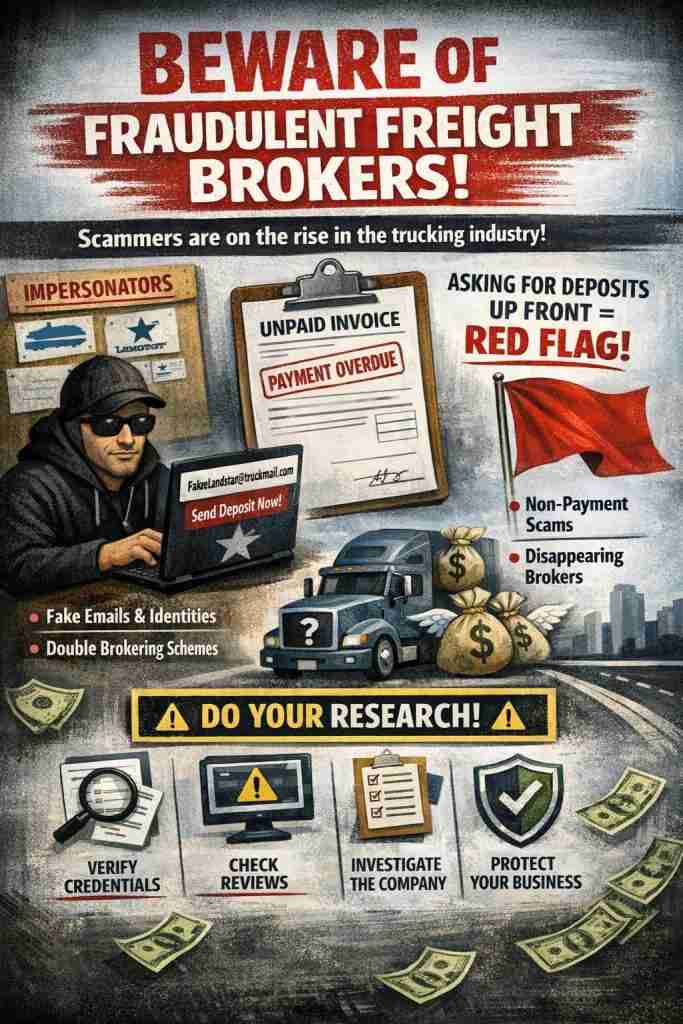
1. They ask for money up front
A request for a deposit before service, especially under pressure, is a major warning sign.
2. Their identity does not hold up under scrutiny
Watch for:
3. They cannot clearly prove authority
A legitimate interstate broker should be verifiable through FMCSA records and should have identifiable registration details.
4. They push urgency over documentation
Common pressure tactics include:
5. There are signs of double-brokering
Potential signals:
6. Their reputation is difficult to verify
Be cautious when:
Use a simple verification process
Check 1: FMCSA registration
Confirm the broker is properly registered and that the business details match what you were given.
Check 2: Complaint history
Review available complaint records and look for patterns, not just one-off issues.
Check 3: Company identity
Compare the email domain, phone number, website, physical address, and contact names.
Check 4: Payment practices
Be wary of unusual payment requests, changed remittance details, or demands for deposits.
Check 5: Documentation consistency
Make sure rate confirmations, MC/DOT details, certificates, and contact information all align.
Check 6: Independent research
Search the company outside of the information they sent you. Do not rely only on their website or email signature.
Practical protection steps
A few extra minutes of verification can prevent weeks of collection issues, operational disruption, and reputational damage.
Take action immediately
Protect your freight operation with a repeatable screening process for every new broker. Always verify broker registration, business identity, and complaint history before doing business. Fraudsters often rely on speed, confusion, and lookalike branding.
Manitoba Trucking Association
https://trucking.mb.ca/
Permits Canada
https://www.permitscanada.com/
Safety & Fitness Electronic Records (SAFER)
https://safer.fmcsa.dot.gov/
Freight Broker Watchlist
https://transportationrecovery.com/broker-alerts/
Keystone Insurance Brokers was built by bringing together several trusted independent brokerages serving Southern Manitoba communities for decades.
Our roots trace back to 1995 in Crystal City, when Treble Insurance began serving local families, farms, and businesses. Over time, brokerages in Souris, Cartwright, and Pilot Mound joined together, forming what is now Keystone Insurance Brokers.
Today, Keystone provides trusted insurance advice across Winkler, Morden, Morris, Crystal City, Pilot Mound, Cartwright, Killarney, and surrounding communities, protecting everything from family homes and farms to commercial businesses and trucking operations.
Fill out the form below, and we’ll get back to you as soon as we can, typically within 1 business day.